 Ole-Morten Duesund
fc752cfa0c
Ole-Morten Duesund
fc752cfa0c
'Path tracing' in graphics literature means Monte Carlo solution of the
rendering equation, with random hemisphere sampling at every diffuse
surface and indirect light transport. card.cc has none of that — the
floor branch in S() returns immediately with a flat ambient term and
casts no new rays. What it actually does is Whitted-style recursive
specular reflection (mirrors only), with distribution-style stochastic
sampling layered on top for soft shadows, depth of field, and AA.

Group the stochastic features (soft shadows, DOF, AA) under that
qualifier; keep mirror reflections, checker floor, and sky gradient
as separate non-stochastic features.
3.7 KiB
card-raytracer
A study of Andrew Kensler's "business card raytracer" — a complete Whitted-style raytracer with stochastic sampling for soft shadows, depth of field, and anti-aliasing, plus mirror reflections, a checker floor, and a sky gradient, all crammed into a single C++ source file small enough to print on the back of a business card.
card.ccis exactly 1337 bytes. Yes, leet. Verify it yourself:$ wc -c card.cc 1337 card.ccThat is suspiciously round — hand-golfed C++ rarely lands on a famous leet number by accident. The compression tricks all show their work: typedefs (
iforint,fforfloat), operator overloads onstruct vthat turn+/%/^/!into vector math, and not a wasted space anywhere.
The original code is preserved verbatim as card.cc. A
de-obfuscated, heavily-annotated rewrite lives in
card_explained.cc. Both produce the same image:
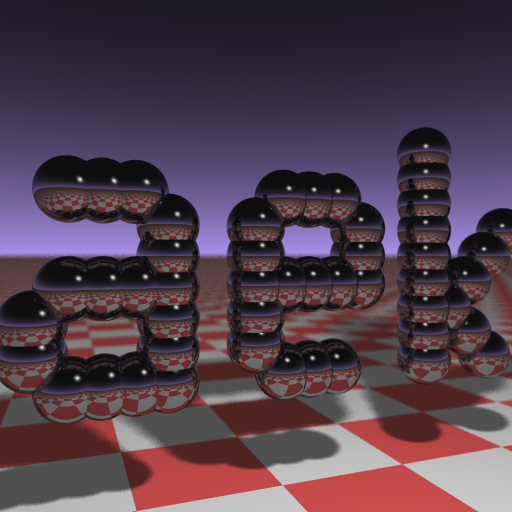
The spheres spell a · e · k, Andrew Kensler's initials, encoded as a
9-column bitmap in the G[] array of the original source.
Quick start
Requires a C++14 compiler, CMake ≥ 3.16, and (optionally) netpbm for
PPM → PNG conversion.
cmake -S . -B build
cmake --build build

# Render with the original (PPM, 786 KiB, ~6 s on a modern laptop)
./build/card > aek.ppm

# Or via the convenience target:
cmake --build build --target image            # → build/aek.ppm
cmake --build build --target image_explained  # → build/aek_explained.ppm

# View it (PPM is supported by most image viewers; or convert):
pnmtopng aek.ppm > aek.png
What's interesting about it
The whole renderer is built on operator overloading: a single struct v
provides + (add), * (scale), % (dot product), ^ (cross product), and
unary ! (normalise). Once those are in place, the entire rendering
pipeline — sphere intersections, reflection vectors, Phong shading,
checker-pattern tile lookup, camera basis construction — collapses into
just a handful of expressions.
Other tricks worth admiring:
- Soft shadows for free: the light position is jittered each call, so averaging 64 samples per pixel produces a real penumbra without any area-light formalism.
- Depth of field for free: the camera origin is also jittered across a 99-unit "lens" each sample, so points off the focal plane go blurry.
- Anti-aliasing for free: sub-pixel jitter on the ray direction.
The same 64-sample loop pays for all three at once.
A line-by-line walkthrough of the algorithm is the long-form
comments inside card_explained.cc.
Layout
.
├── card.cc            # original, untouched — do not edit
├── card_explained.cc  # de-obfuscated, documented rewrite
├── CMakeLists.txt
├── docs/
│   └── aek.png        # published render
├── README.md
└── CLAUDE.md          # working notes for AI assistance
Credits
- Original raytracer: Andrew Kensler ("aek").
- Excellent walkthrough that inspired this study: Fabien Sanglard, Decyphering The Business Card Raytracer.
Licence
The original card.cc is reproduced as-is from publicly published material
for educational purposes; credit and copyright belong to Andrew Kensler.
The supporting files in this repository (CMake, README, de-obfuscated
rewrite) are placed in the public domain by the repository author.